


On the Job Training Benefits for Autistic Adults
The most popular advice about on-the-job training benefits is also the least useful: put someone in a workplace, let them observe, and assume the experience will build confidence and employability. That approach confuses exposure with training. For autistic adults, a placement can create lasting earnings and retention, but only when the work is paid, the tasks are meaningful, supports are individualized, and the job leads somewhere beyond the training period.
The evidence points to a more demanding question. Which training models transfer skills into real employment, fair compensation, and long-term attachment to work? A recent scoping review found strong outcomes in personalized supported employment and other employer-based models, while sheltered-workshop-style pathways cost more, paid less, and didn't improve employment outcomes or hours worked compared with competitive integrated employment (scoping review of employment models for autistic people).
That distinction matters for trainees, families, and employers. A program can call itself vocational training while offering little skill progression, limited choice, and no credible route to competitive work. Good design matters more than the label.
Table of Contents
Why Most On-the-Job Training Advice Misses the Point - Training quality beats training labels
How On-the-Job Training Actually Works - OJT isn't the same as every workplace pathway
Industry Horror and the Nonprofit Pay-and-Learn Model - What pay and learning look like together
Which Training Models Produce Long-Term Results - A practical comparison
Building Benefit-Compatible Training Pathways - A safer progression
Why Most On-the-Job Training Advice Misses the Point
Time spent near a workplace does not create a career by itself. A career develops when a worker learns tasks an employer values, receives usable feedback, earns fairly, and gains access to greater responsibility. On-the-job training succeeds when the workplace operates as both a learning environment and a real job.
That standard matters particularly for autistic and neurodivergent adults. A trainee may need predictable routines, clear instructions, visual supports, sensory adjustments, or a gradual introduction to workplace communication. These supports do not indicate lower ability. They are training conditions, much like safety equipment and written procedures in other skilled occupations.
The outcomes also depend on how support is organized. The scoping review cited above found that personalized supported employment produced employment rates as high as 82%. A place-then-train model in Ireland reported 56% employment, and one study reported 87.1% retention at 18 months (scoping review of employment models for autistic people). Those findings point toward individualized support and early job integration, while leaving room for an important caution: a program does not produce the same results solely because it uses the label “supported employment.”
Training quality beats training labels
A sheltered workshop can provide repetition and close supervision while still offering low pay and no route into an ordinary workplace. Competitive integrated employment places the worker alongside other employees and provides individualized help that can reduce as skills and independence grow.
A useful program includes:
Real work: The trainee completes tasks that contribute to an operating business, rather than exercises that have no effect on customers or workflow.
Paid participation: Wages recognize the worker's contribution and make employment part of the learning process.
Job carving: The employer shapes duties around the worker's strengths and business needs instead of requiring an identical role for everyone.
Customized support: A coach or supervisor adjusts communication, pacing, sensory conditions, and feedback.
Progression: The program identifies the next skills to develop, such as speed, accuracy, customer interaction, equipment use, or broader responsibility.
Ask one direct question: what happens when training ends? A specific job, documented skill progression, or defined employer transition indicates a pathway. Without one, the program may offer experience without building a career.
The strongest on-the-job training benefits come from skill transfer, not attendance. The worker should leave with abilities that apply in another role, greater bargaining power, and a record of successful paid work. That standard separates a placement that looks positive on paper from training that can support long-term earnings and retention.
How On-the-Job Training Actually Works
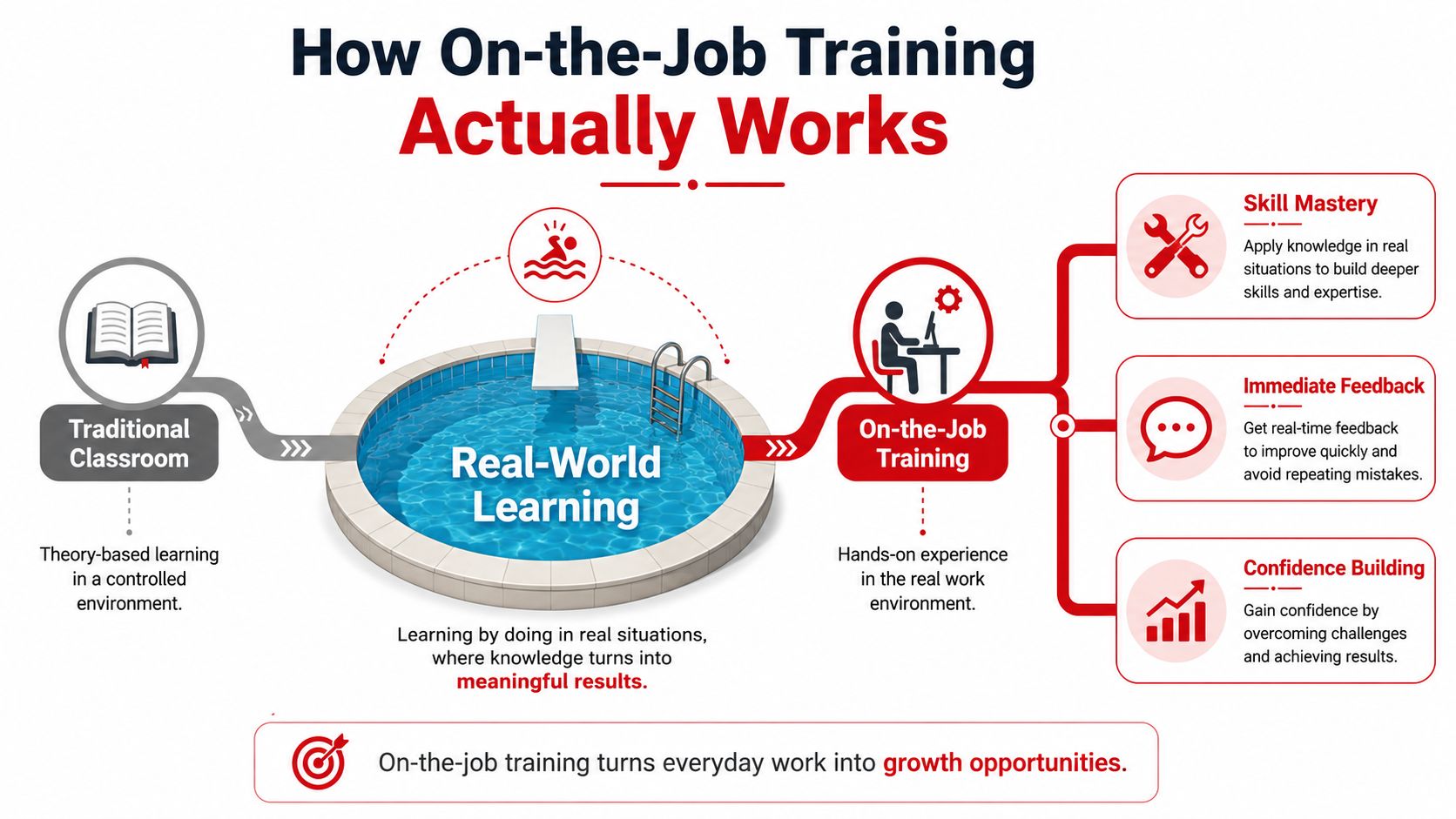
Classroom instruction can explain how to greet a customer, prepare an order, operate equipment, or check inventory. On-the-job training lets the learner perform those tasks while the setting, tools, timing, and consequences are real. It resembles learning to swim in a pool instead of only reading about swimming. The learner develops practical memory, receives immediate feedback, and learns how separate actions fit into a complete workflow.
A well-designed model usually combines four elements:
Task-specific learning: The trainee breaks a job into observable steps. A supervisor might demonstrate order fulfillment, then have the trainee repeat the sequence with a checklist.
Workplace socialization: The learner practices asking for clarification, responding to a customer, joining a team routine, and communicating when a task is complete.
Mentorship: A consistent supervisor or job coach provides feedback in the same way each time, reducing uncertainty.
Paid contribution: The trainee earns wages while performing productive work, rather than waiting for employment to begin after an unpaid trial.
The World Bank's review of on-the-job training associates workplace learning with higher worker wages and higher firm productivity, including benefits that can extend beyond the directly trained employee (World Bank review of on-the-job training). The reason is straightforward. When learning happens inside the workflow, the worker can apply a new skill immediately, and the employer can observe what support produces better results.
OJT isn't the same as every workplace pathway
An apprenticeship normally follows a structured occupational framework and may combine paid work with related instruction. An internship can provide exposure, but it may be unpaid or loosely connected to future employment. Classroom vocational education builds foundational knowledge and can prepare someone for a placement, but it can't reproduce every sensory, social, or operational demand of a real workplace.
Job shadowing sits closer to observation than performance. It can help someone explore whether a setting feels suitable, but it shouldn't be confused with paid skill development. The distinction is explained clearly in this overview of job shadowing.
For a practical example of how a trade skill can develop through guided workplace learning, readers can also consult this guide from Display Guru on becoming a tailor. The important lesson isn't the specific occupation. It's the sequence of demonstration, supervised practice, correction, and increasing independence.
A retail trainee might learn to fold and label merchandise, process an online order, prepare a package, and then handle a customer question. In a clothing environment, a product such as the Here to Wreck Ship Youth T-Shirt Black can become part of a real inventory, fulfillment, and customer-service workflow rather than a classroom prop.
Measurable Gains for Trainees and Employers
The strongest evidence points to a two-sided return from workplace training. Trainees develop skills they can use in paid roles, while employers teach those skills in the same setting where accuracy, speed, and service are evaluated. A certificate has limited value if the learner cannot perform the work.
Australian government data illustrates the connection. After training, 95.4% of trade completers and 89.4% of non-trade completers were employed. 91.7% of trade completers and 88.6% of non-trade completers reported satisfaction with the skills learned on the job (2024 Australian government report on apprentices and trainees). Trade-completer employment outcomes were similar to those in 2023, suggesting a continuing pattern rather than a one-off result.
UK apprenticeship research found the same broad relationship between learning and work. 99% of apprenticeship completers said they gained skills, 95% reported at least one positive impact on their job or career prospects, and 94% were working at the time of interview (UK apprenticeship evaluation). Employment among respondents was 92% at survey time, compared with 78% before participation. Among completers, employment was 94%, compared with 88% among non-completers.
Country or study | Employment rate post-training | Skill satisfaction | Key finding |
|---|---|---|---|
Australia, trade completers | 95.4% employed | 91.7% satisfied | Workplace training connected practical learning with immediate employment |
Australia, non-trade completers | 89.4% employed | 88.6% satisfied | Non-trade pathways also showed strong labor-market attachment |
United Kingdom, apprenticeship completers | 94% employed at interview | 99% gained skills | Completers described skill gain and positive career impact |
Employer results matter just as much. Firm-level evidence estimates that a 10 percentage-point increase in the share of trained workers is associated with 1.7% to 3.2% higher productivity, while average wages rise 1.0% to 1.7% (IZA working paper evidence). The pattern suggests that training can produce productivity gains larger than the associated wage increase. That does not justify holding down pay. Employers still need to compensate workers fairly and define productivity expectations clearly.
For autistic trainees, the practical test is whether training builds skills that survive beyond one supportive placement. A task should have a clear sequence, observable quality standards, and feedback that helps the worker adjust. Supervisors can then track accuracy, completed steps, prompt levels, handoffs, and customer interactions instead of relying on vague impressions of confidence.
Training is therefore a business investment, not merely a hiring expense. In repeatable jobs with timely feedback, workers improve while producing useful output. Employers may recover part of the investment through fewer errors, smoother handoffs, stronger customer service, and less need for constant supervision. The Industry Horror pay-and-learn model provides a concrete example of how those gains can be tied to real work rather than classroom completion alone.
Industry Horror and the Nonprofit Pay-and-Learn Model
Industry Horror offers a concrete example of paid workplace learning through a 501(c)(3) autism employment-based clothing company in Ventura, California. Since 2013, the organization has provided paid job training and long-term employment for autistic adults in customer service, order fulfillment, printing, and workplace readiness.

The model starts with actual business activity. A trainee may process an online order, locate an item, check it against the order, package it, and prepare it for shipment. Another worker may learn customer-service routines in the retail shop at 518 E Main Street, including greeting visitors, answering questions, organizing merchandise, and completing workplace tasks with appropriate support.
This sequence gives supervisors something concrete to teach and trainees something concrete to master. Instead of saying “improve communication,” a coach can teach a specific behavior, such as acknowledging a customer, asking a clarifying question, or notifying a supervisor when an order needs attention. Instead of saying “be more independent,” the team can track whether the worker completes a defined process with fewer prompts.
What pay and learning look like together
The pay-and-learn model changes the relationship between trainee and organization. The person isn't merely receiving a service. They're contributing to production and receiving compensation while developing capability. That arrangement can support dignity, motivation, and a clearer understanding of what employment involves, while supervisors can adjust tasks without pretending that every worker needs the same route.
Industry Horror's retail and production setting also creates multiple entry points. Someone may begin with sorting or packaging, then build toward printing, inventory, customer service, or broader workplace readiness. A strong program doesn't rush every trainee into the same role. It identifies a useful starting point and adds complexity as the worker demonstrates readiness.
The organization's paid training programs show why a nonprofit business can function as a training site and an employer at the same time. Purchases from its apparel line help fund on-the-job learning in the same areas the business operates, connecting community participation with employment opportunity.
The following video provides another way to understand the organization's work. It should supplement, not replace, a conversation about wages, supports, skill goals, and what progression looks like for each trainee.
This model isn't a promise that every worker will follow the same timeline. Its value lies in the structure: real tasks, paid participation, individualized support, and a business context where skills have a purpose.
Which Training Models Produce Long-Term Results
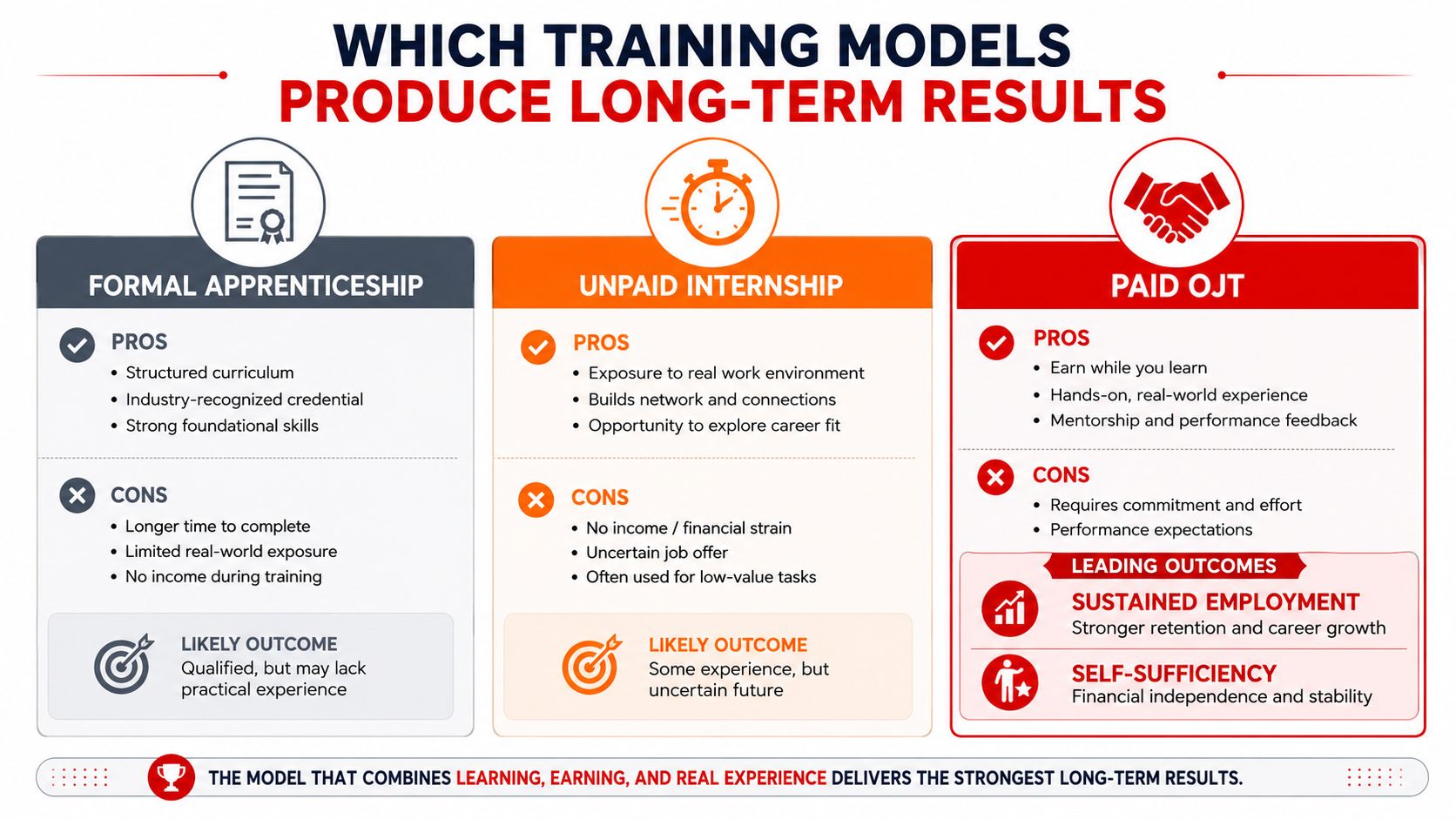
Training works only when it connects directly to paid work and a next step. For autistic adults, a useful pathway answers four practical questions: What tasks will I perform? What will I be paid? What support will I receive? What changes when I become more capable?
The strongest models treat placement as the beginning of training, not its conclusion. A scoping review of employment models for autistic people reported employment rates as high as 82% for personalized supported employment, while a place-then-train pathway reported 56% employment. The review also described 87.1% retention at 18 months in one study. Initial placement matters, but keeping the job is the harder test.
A practical comparison
Personalized supported employment starts with the worker's strengths, preferences, and support needs. A provider and employer identify a suitable role, adjust duties, and coach the worker in the workplace. The support can continue after hiring, which gives the job match time to prove itself and allows adjustments when real conditions differ from an interview or work sample.
Place-then-train puts the worker into a real job before every task has been mastered. Coaching happens at the point of performance, much like learning a route by traveling it with a guide rather than studying a map alone. This approach can shorten the distance between preparation and productivity, provided the employer schedules coaching and makes reasonable adjustments.
Competitive integrated employment places autistic workers in ordinary paid roles alongside employees who are not receiving disability services. Job carving can strengthen the match by separating essential tasks, assigning responsibilities according to strengths, and creating a role that meets a real business need. Readers who need the broader framework can review this guide to supported employment and how it works.
Sheltered-workshop-style pathways may provide a controlled practice setting, yet the review found that they cost more, paid less, and did not improve employment outcomes or hours worked compared with competitive integrated employment. A practice site has value when it leads toward integrated paid work. It becomes a holding pattern when participation replaces that destination indefinitely.
A placement is not a long-term success if the worker cannot build income, bargaining power, or a realistic next step.
The Employ Autism evaluation adds an important benefits perspective. In the 2024 evaluation, 34% of interns were claiming benefits, mostly sickness or disability-related support, and employment rose from 26% before the internship to 56% in the two years afterward (Employ Autism evaluation). These results do not establish one correct pace for increasing hours. They show why job coaching should be paired with benefits guidance, so paid work does not become an avoidable source of uncertainty.
Use five questions to assess any program:
Integrated setting: Does training occur in a workplace connected to ordinary employment?
Compensation: Are wages paid for productive work?
Customized supports: Can duties, communication, and sensory conditions be adjusted?
Retention plan: Does support continue after placement?
Progression: Is there a route to more hours, broader tasks, higher responsibility, or another competitive role?
The model matters more than its promise. Paid, integrated, customized training has the clearest logic for long-term earnings and retention.
Building Benefit-Compatible Training Pathways
Fear of losing essential benefits can make a paid job feel risky. Families may worry that a modest increase in earnings will trigger a sudden loss of healthcare, housing stability, or other supports. Employers can't solve every benefits rule, but they can avoid pushing workers into an abrupt transition without planning.
Start with a benefits counselor before hours or wages change. The counselor can explain the specific rules that apply to the worker's program, identify reporting responsibilities, and outline how earnings may affect support. Don't rely on informal advice from a supervisor, family friend, or online discussion.
A safer progression
A thoughtful pathway may include:
Map the current situation. Record which benefits the worker receives, who administers them, and what documentation must be maintained.
Increase work gradually. Begin with duties and hours that match current stamina, then review performance and support needs before expanding the role.
Document skill growth. Keep a plain-language record of tasks mastered, prompts reduced, accommodations used, and responsibilities added.
Coordinate supports. Involve vocational rehabilitation, a job coach, the employer, and benefits professionals so each person understands the plan.
Review the long-term goal. Revisit whether the worker wants more hours, a different role, additional training, or a stable level of employment that fits their priorities.
The gradual approach isn't about limiting ambition. It protects the worker from a forced leap and gives the team time to check whether wages, hours, transportation, health, and support arrangements remain workable.
Benefits planning should begin before the first paycheck changes, not after a problem appears.
Employers should also ask whether coaching will fade, how the worker can request an accommodation, and who handles paperwork. Programs may reference tools such as Ticket to Work, but the worker still needs individualized guidance about eligibility and fit. A benefits-safe pathway should never promise that a particular program will protect every benefit.
Families can ask a provider for a written answer to five questions: What are the wages? Which tasks are paid? Who provides coaching? How will progress be measured? Who will coordinate benefits advice? Clear answers reveal whether the program has designed a transition or expects the worker to manage complex systems alone.
Next Steps for Trainees Families and Partner Employers
Autistic adults can test a training pathway before committing to it. Ask to visit the workplace, observe the actual duties, and discuss pay, feedback, accommodations, and possible progression beyond the first role. A useful pathway should make the next step visible, like a route with marked stops, rather than treating training as an open-ended placement.
Families and caregivers can ask whether the program leads to paid, integrated employment and how success will be measured after onboarding. Bring vocational rehabilitation and benefits counseling into the discussion early. Review retention, skill progression, hours, worker choice, and the supports needed to keep the job. Attendance alone cannot show whether training is producing durable employment.
Employers can begin with one defined role and a manageable set of repeatable tasks. Assign one consistent supervisor, write plain-language procedures, and set dates to review coaching and reduce prompts when appropriate. Structured training can support productivity, while fair pay remains part of the employment agreement.
Industry Horror offers local trainees and supporters access to paid workplace learning through customer service, order fulfillment, printing, and community programs. Ventura County residents can explore volunteering, sponsorship, the annual Autism Rocks Car Show, and the proposed Autism Avenue Trade School initiative.
Industry Horror offers paid job training and long-term employment for autistic adults through real customer service, order fulfillment, printing, and workplace-readiness work. Visit Industry Horror to learn about training pathways, community participation, volunteering, and ways to help expand sustainable employment.


Comments