


How to Improve Customer Service for Neurodivergent Teams
A customer walks up while two teammates are already helping other people, the music is on, a phone is buzzing, and the trainee at the counter is trying to remember whether to ask one more question or just ring the sale. That's the moment customer service gets real. In a mission-driven shop, the interaction isn't only about the transaction. It's also about whether the customer feels seen, whether the trainee feels steady, and whether the floor can keep moving without everyone getting overwhelmed.
Good service in that setting starts with clear routines, sensory-aware space, and coaching that respects how people process information. It also means measuring what matters, especially response speed, because customer expectations are now compressed into minutes, not hours. In recent customer-service research, customers expected brands to respond on social media within 1 hour, nearly 40% expected a response in less than 60 minutes, and 90% expected an immediate response to a support question, defined as 10 minutes or less.[^1] That doesn't mean every shop needs to act like a call center. It does mean speed, clarity, and follow-through are no longer optional.
For a practical framing on how improving service can support a shop's broader goals, Cobra DTF's guide on boost print shop loyalty and revenue is a useful companion read. The key difference here is that the team delivering service matters just as much as the service itself.
Table of Contents
Why Customer Service Looks Different in a Mission-Driven Shop
The Four Training Modules Every Team Actually Needs - Greeting and first impressions - Product knowledge and storytelling - Handling questions and returns - De-escalation
Role-Based Checklists for Cashier, Floor, Online Orders, and Printing - How to score the checklist
Sensory and Communication Accommodations That Improve Every Interaction - What to change in the space - What to change in the conversation
On-the-Job Coaching That Builds Real Confidence - Coaching after a rough interaction
Sample Scripts for the Scenarios You Will Actually Face - Greeting a browsing customer - Answering a sizing question - Processing a return without a receipt - Helping a customer who's overwhelmed - Following up on an online order question - Closing a sale with a mission-focused thank-you
Why Customer Service Looks Different in a Mission-Driven Shop
On a Saturday at Industry Horror in Ventura, a customer asked about a sweatshirt, a trainee froze for half a beat, then reached for the written product card instead of guessing. That tiny accommodation changed the whole interaction. The customer got a clear answer, the trainee stayed regulated, and the sale kept moving without the awkward drift that happens when someone tries to improvise under pressure.
That's the shape of how to improve customer service in a shop where autistic adults are learning on the job. The goal isn't polished small talk. It's dependable service, with enough structure that a trainee can succeed even when the floor is noisy or the line is long. In a place like Industry Horror, every customer interaction also doubles as practice for paid job training in customer service, order fulfillment, printing, and workplace readiness.
Practical rule: If the customer can get the answer from a written card, the trainee should not have to invent one on the spot.
A mission-driven shop also needs recovery routines. If a customer asks a confusing question, or a return gets tense, the team can't treat that as a personal failure. The better move is to reset the environment, clarify the next step, and keep the interaction moving. That's a service design choice, not just a people-management choice.
This is also why the usual retail advice falls short. Generic scripts and “be friendly” training don't tell a team how to support someone who processes language more slowly, needs predictable steps, or works better with a visual cue than with a verbal prompt. In this setting, accessibility isn't a side note. It's the operating system.
The Four Training Modules Every Team Actually Needs
Most service training collapses everything into “communication” or “problem-solving,” and that's too vague to use on a floor with real customers. A small nonprofit retail team needs four modules that can be taught, practiced, and checked in real time. The point is to make the work repeatable, not to overwhelm trainees with theory.
Greeting and first impressions
Start with a simple greeting script and a body-position habit. A trainee practices making eye contact if that feels comfortable, greeting within a reasonable pause, and offering help without crowding. A good exercise is role-playing three customer moods, browsing, uncertain, and hurried, then asking the trainee to match tone to situation. Readiness shows up when the trainee can greet without freezing and can stop talking long enough for the customer to answer.
Product knowledge and storytelling
Product knowledge only matters if the trainee can use it in customer language. A short training activity is to pick one item, then have the trainee explain what it is, who it suits, and what makes it different from a similar item. If the product is the Vintage Ventura Crewneck Sweatshirt Heather Grey, the trainee can practice describing the 100% Cotton, sensory friendly crewneck in plain language instead of reading a label word for word. Readiness means the trainee can answer a basic question without drifting into guesswork.
Handling questions and returns
This module should be practiced with real forms, real policies, and real pauses. A trainer can hand the trainee a mock return, a sizing question, and an online order inquiry, then watch whether they ask for clarification before acting. Readiness is less about speed here and more about accuracy under light pressure.
De-escalation
De-escalation needs the most rehearsal because it's the hardest to improvise. Have trainees practice a calm phrase, a boundary phrase, and a handoff phrase. A trainee is floor-ready when they can stay steady, avoid arguing, and bring in a lead before the interaction gets heated.
For point-of-sale specifics, this POS training guide fits well alongside role practice. It's easier for trainees to succeed when the teaching matches the exact task they're expected to perform.
Role-Based Checklists for Cashier, Floor, Online Orders, and Printing
A role checklist removes ambiguity, which is especially helpful for autistic adults who do better with written expectations than with vague coaching. The checklist should name the action, not just the attitude. “Stay calm” is too abstract. “Repeat the total, then wait for confirmation” is usable.
Role | Key Action | Skill Being Trained |
|---|---|---|
Cashier | State the price, process payment, and confirm the receipt method | Accuracy under time pressure |
Floor | Greet, answer one question, and offer one next step | Active listening and guided conversation |
Online Orders | Verify item, size, and shipping details before closing the task | Detail checking and follow-through |
Printing | Confirm the design file or print instructions before starting | Asking for clarification |
How to score the checklist
Use a simple three-point read. Done independently, done with a prompt, or not yet. That gives the trainer a clean way to track progress without turning the shift into a test. Review the checklist at the end of the shift, not in the middle of a rush, unless there's a safety or customer issue to resolve immediately.
A checklist also helps the trainer avoid mixed messages. If one coach says “be more independent” and another keeps stepping in, the trainee gets a confusing signal. Written role notes keep expectations stable across shifts, which matters more than people think.
The client experience design playbook is a helpful reference if you want to think about service as a repeatable system rather than a collection of one-off interactions. That mindset fits small teams, because it forces the team to decide what the customer should always experience and what the trainee should always know.
Sensory and Communication Accommodations That Improve Every Interaction
Accommodations often get framed as special treatment, but the same changes that help neurodivergent staff usually improve service for everyone. Written instructions reduce memory load. Predictable routines reduce mistakes. A quieter corner helps a customer make a choice without feeling rushed.
What to change in the space
Keep lighting as even as possible, reduce unnecessary background noise, and designate one calmer spot for complex conversations or returns. If a customer needs time to compare options or process a policy, that quiet corner gives the interaction a place to slow down without dragging the whole floor into it. That's not indulgence. It's a service tool.
What to change in the conversation
Train staff to offer information in chunks and to normalize pauses. A simple phrase like, “I can repeat that, or I can write it down for you,” gives the customer control without making the interaction awkward. Another useful script is, “Take your time. I'll wait while you look.”
A customer who hears the same explanation twice in a calm tone is easier to help than a customer who hears it once in a hurry.
Communication adjustments matter after the interaction too. A written receipt, a follow-up email, or a short text can prevent repeat questions and keep the customer from having to remember everything in the moment. If you want a deeper look at practical workplace adjustments, this autism workplace accommodations guide covers the same principle from the staff side.
On-the-Job Coaching That Builds Real Confidence
Classroom training rarely survives contact with a busy floor. People learn the job when they do the job, with someone nearby who can correct course without making the trainee feel watched. A steady coaching rhythm beats a long lecture every time.
A simple weekly pattern works well in small teams. Start with a five-minute pre-shift huddle, then shadow one task, then debrief with the same three questions: What went well? What felt hard? What's the next step? End by writing down one win and one focus point. That note matters because trainees often forget progress faster than coaches do.
The best coaching is direct. Say what happened, say what to do next, and don't wrap it in personality language. “You were too nervous” is hard to use. “You looked at the register before you asked for the email. Next time, ask first” gives the trainee a clear behavior to repeat or change.
For a broader framework on supported learning, this what is job coaching guide pairs well with the day-to-day approach here. The main idea is simple. Coaching is part of service delivery, not something separate from it.
Coaching after a rough interaction
A bad return can teach more than a perfect sale if the debrief stays calm. Start with the facts. “The customer disagreed with the policy, you got quiet, and I stepped in.” Then move to the skill. “Next time, use the boundary phrase earlier and call for backup sooner.” Avoid moralizing. The goal is to build repeatable behavior, not to assign shame.
Metrics should stay just as practical. A small team can track first response time for customer messages, return rate as a quality signal, repeat customer visits, and one weekly trainee confidence score. That fits the service-management shift toward measurable standards, like CSAT and first response time, without drowning a tiny shop in dashboards. One common CSAT method scores the percentage of respondents who rate an interaction 4/5 or 5/5, multiplied by 100.[^2] Keep the measurement set small enough that staff can act on it.
Coach the behavior, not the personality. Trainees improve faster when feedback is about words, steps, and timing.
Sample Scripts for the Scenarios You Will Actually Face
Scripts help because they reduce improvisation pressure. They're not meant to make staff sound robotic. They're meant to give a trainee a safe starting point when the room is loud, the customer is uncertain, or the answer needs to be exact.
Greeting a browsing customer
Goal, make contact without pressure.
Script, “Hi, welcome in. Let me know if you want help finding anything.”
Practicing this teaches tone and pacing. The trainee learns that a greeting can be brief, warm, and low-pressure all at once.
Answering a sizing question
Goal, give a clear answer and a next step.
Script, “That size runs a little different from our other shirts. I can check the chart with you, or I can measure it if you'd like.”
This trains offering choices instead of guessing. It also keeps the customer involved in the decision.
Processing a return without a receipt
Goal, stay steady and explain the policy.
Script, “I can look at the item and check what options we have. If I need a lead to review it, I'll bring them in.”
That phrasing protects the trainee from overpromising. It also reduces panic when a policy decision needs backup.
Helping a customer who's overwhelmed
Goal, lower stimulation and create space.
Script, “We can step over here where it's quieter. I can repeat the options one at a time.”
This one is especially useful in a busy shop because it models accessibility without making a scene.
Following up on an online order question
Goal, acknowledge the issue and gather specifics.
Script, “I can help with that. Send me the order name or number, and I'll check the details for you.”
That keeps the interaction structured and protects accuracy.
Closing a sale with a mission-focused thank-you
Goal, connect the purchase to the shop's purpose without overexplaining.
Script, “Thanks for supporting the shop. Your purchase helps fund the training here.”
This teaches mission language that feels natural, not performative.
Some phrases should be avoided because they sound polite but create pressure. “No worries” can minimize a real issue. “I'm sure it's fine” can sound careless. “What do you want me to do?” puts the burden back on the customer. Better to use calm, specific language that says what happens next.
Turning Community Engagement Into Better Customer Service
A shop that shows up in its community earns a different kind of attention at the counter. People come in already familiar with the mission, the events, the training, and the way the team communicates online. That familiarity does not erase service problems, but it gives the staff more room to recover when something goes wrong and makes the next interaction easier.
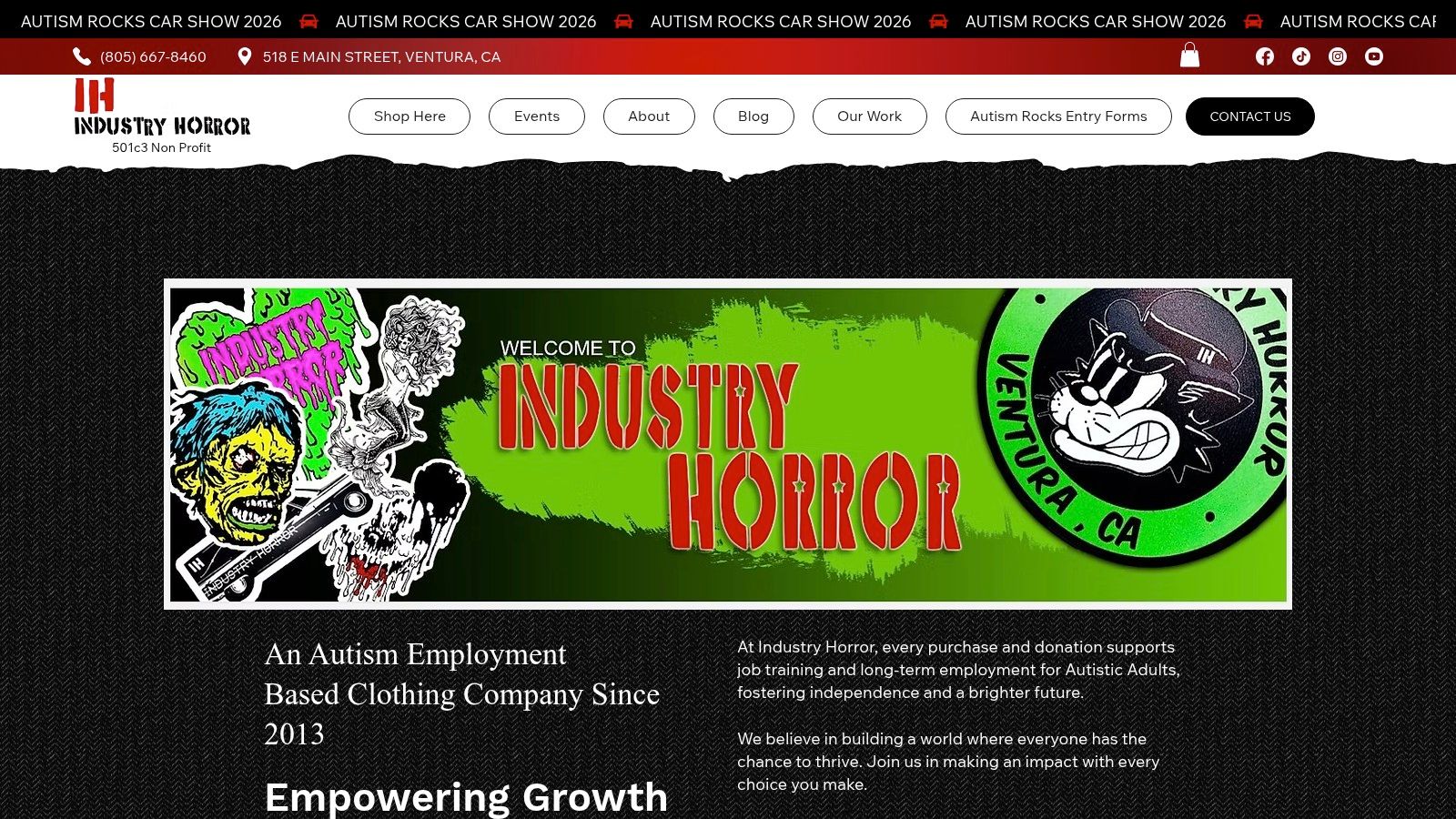
At a place like Industry Horror, a sale is tied to more than merchandise. It supports paid job training in customer service, order fulfillment, printing, and workplace readiness. Community engagement and service quality sit in the same system, because every shirt, sticker, or limited release helps sustain the training work behind it.
That connection changes how a service hiccup feels. A return is easier to handle when the customer understands the team is still learning and that clear communication matters. A slower reply feels less personal when the shop has already built a steady pattern of honest updates and accessible support. None of that excuses a mistake, but it does make repair possible.
The Autism Rocks Car Show and the shop's workshops show how public events extend the customer relationship beyond the register. They give supporters a reason to come back, ask questions, and see the people doing the work. Customers who feel attached to the mission usually have more patience, and that patience gives trainees more room to build skill.
A practical 30-day rollout keeps the effort manageable. Start by auditing one bottleneck, such as returns or online replies. Then pilot one training module with one trainee, add one metric, and review it at the end of the week. Finish by running one community touchpoint and checking what changed in customer behavior and staff confidence.
The main point is straightforward. How to improve customer service in a neurodivergent-friendly, mission-driven shop starts with the people doing the work, not just the systems they use. If you want to see that approach in practice, visit Industry Horror, shop online, stop by 518 E Main Street in Ventura, or follow the newsletter and blog for more resources and updates.
If you're building a team that needs structure, patience, and practical customer service training, Industry Horror shows one way to do it without losing the human side of the work. Visit Industry Horror to support paid training, browse the shop, and see how mission-driven retail can turn everyday service into long-term opportunity.


Comments