


Job Search Strategies for Autistic Adults in 2026
You've done everything “right.” The resume is polished, the cover letter is customized, and you still leave an interview feeling like the room rewarded small talk, forced eye contact, and fast social performance more than actual competence. For many autistic adults, that mismatch is the core problem, not a lack of skill. Traditional job search strategies often assume a neurotypical style of networking, self-promotion, and spontaneous conversation, which means talented candidates get screened out for reasons that have little to do with the work.
The good news is that the market has shifted in ways that support a different approach. In 2025, job seekers were already using AI tools at scale, with Huntr reporting that 93% were using AI tools in their search by Q2 2025, and another 2025 report putting adoption at 86%. At the same time, platform performance varied sharply, with Google Jobs and employer portals often outperforming broad job-board volume, and direct applications inside ATS-heavy systems becoming a skill in itself. Huntr's 2025 job search trends research and the related Q3 platform response analysis make the same point in different ways, job searching now rewards targeting, tailoring, and support.
For autistic and neurodivergent job seekers, that means the best path is usually not “apply harder.” It's build a search around strength-based supports, clearer communication, real work samples, and employers who already understand accommodation and sustainability. That's the model organizations like Industry Horror have been proving through paid training, community connection, and long-term employment pathways in Ventura, California.
Table of Contents
1. Leveraging Neurodiversity-Affirming Job Programs and Training Organizations
2. Building a Comprehensive Accommodation and Support Plan Before Job Searching
5. Pursuing Internships and Trial Work Periods Before Permanent Placement
6. Customized Employment Carving Niche Roles Based on Individual Strengths
7. Leveraging Disclosure and Workplace Accommodations Strategically
8. Using Informational Interviews to Explore and Build Employer Relationships
9. Developing a Strong Personal Brand and Portfolio Demonstrating Real Work
10. Building Career Readiness Through Mentorship and Role Modeling
Your Path Forward Taking Action on These Job Search Strategies
1. Leveraging Neurodiversity-Affirming Job Programs and Training Organizations
The fastest way to reduce guesswork is to stop beginning with a generic job board. Neurodiversity-affirming programs already know that many candidates need more than a resume review, they need training, employer matching, and support that continues after placement. Industry Horror's own paid training model in Ventura is a practical example, and its job training for autistic adults near me resource is exactly the kind of starting point that can save weeks of random searching.
These programs work because they align the job search with the person, not the other way around. Some candidates do better with hands-on tasks, some need coaching on workplace routines, and some need a hiring process that explains expectations clearly before the first day. That's where specialized organizations can outperform broad, one-size-fits-all advice.
You can also look at options like Specialisterne, Integrate Autism Employment Advisors, and Autism Society employment resources, then ask direct questions about placements and retention. If a program can't tell you what support looks like after hiring, that's a warning sign.
Practical rule: If a program won't explain how it supports the first 90 days on the job, it's probably offering inspiration instead of infrastructure.
A sensory-friendly item can also matter during the search process, especially when you want clothing that doesn't add friction to long days out in the community. The Heels To Heaven T-Shirt White is listed as Unisex Tshirt - Sensory Friendly Cotton, which is the kind of detail that matters when comfort affects how long you can stay regulated during interviews, job fairs, or training sessions.
2. Building a Comprehensive Accommodation and Support Plan Before Job Searching
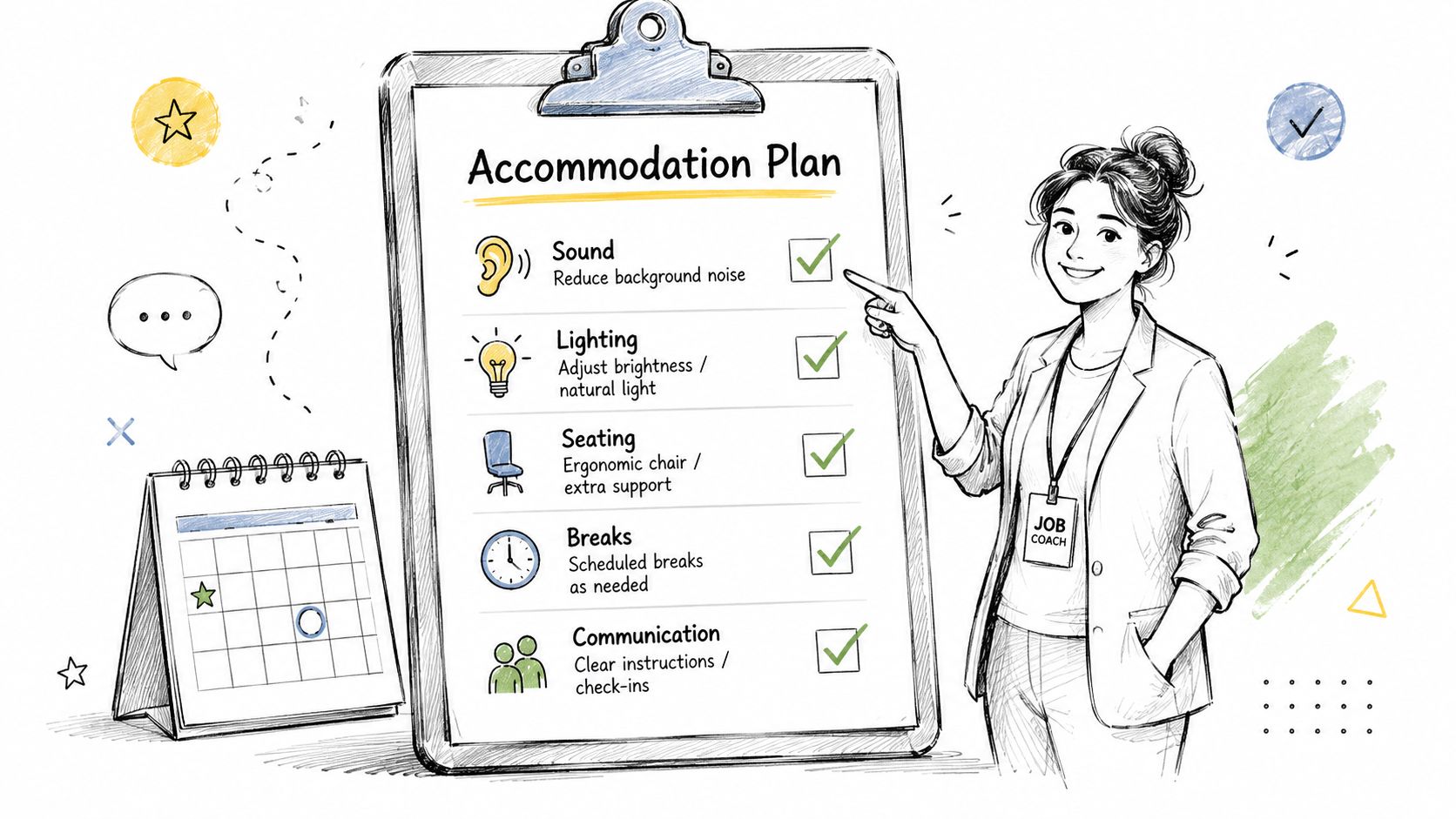
A lot of autistic job seekers are told to disclose only after they're hired. That advice skips the part where you need to know what you need in order to succeed. A stronger approach is to build an accommodation profile before you start applying, so your search targets roles and environments that fit your sensory, communication, and executive-function needs.
Start with a professional who understands neurodivergent assessment, such as a vocational rehabilitation counselor, occupational therapist, or job coach. Then translate broad needs into concrete terms. “I struggle with open-ended verbal instructions” is more useful than “I need support.” “I do best with written task lists and a predictable schedule” gives employers something they can act on.
The 2024 study of low-resourced job seekers makes a useful reminder here, barriers aren't always about motivation. Limited internet access, device quality, transportation, childcare, and bandwidth for repeated applications can all reduce search intensity and follow-through. That study points to a broader truth, lower-friction systems matter.
A flexible support plan should include both essentials and optional supports.
Sensory needs: Note lighting, noise, clothing, seating, and commute issues.
Communication needs: List whether you prefer email, written instructions, or follow-up summaries.
Workflow needs: Identify what helps with transitions, deadlines, and task switching.
Disclosure plan: Draft how you'll talk about accommodations if a role looks promising.
Keep the document revisable. Different jobs need different versions, and you don't want a rigid script that ignores real workplace differences. If you can practice the conversation with a trusted mentor first, even better.
3. Networking Through Community Events and Support Groups
For a lot of autistic adults, “networking” sounds like a punishment. It gets easier when it stops being a room full of strangers and starts being a familiar community where people already understand neurodivergent communication styles. Autism-focused meetups, support groups, disability employment fairs, and events like Industry Horror's Autism Rocks Car Show can create lower-pressure spaces where relationships grow naturally.
The key is repetition. One event rarely changes anything, but showing up regularly makes you recognizable, and recognition lowers social load. That matters because the nature of modern hiring is still relationship-driven, even when applications are online. The 2025–2026 search-length data from High5's job search statistics roundup shows just how sustained the process can be, which makes durable connection-building more valuable than one-time outreach.
Keep the interaction simple. Exchange contact information using the easiest method, then follow up with a short message that reminds the person where you met. If verbal follow-up is stressful, email is fine. If email is stressful, a phone call with notes in front of you can work too.
People often think networking means being impressive. For neurodivergent job seekers, it usually works better when it's consistent, specific, and low-drama.
A trusted support person can also help you stay regulated before and after events. They don't need to speak for you. Their job is to reduce overload so you can focus on the actual relationship-building. Many supporters make the mistake of trying to “perform confidence” for the job seeker, but what usually helps more is simple logistics, transportation, a quiet break, and a clear exit plan.
4. Utilizing Supported Employment and Job Coaching Services
Supported employment exists because many people don't need less ambition, they need a better bridge between ability and workplace expectations. A good job coach helps with task learning, social dynamics, pacing, and problem-solving without taking over the person's role. That balance matters. The point is independence, not dependence.
Industry Horror's approach to integrated coaching is one example, and the broader model is useful across many settings. A coach can help you break a task into steps, rehearse a difficult conversation, or prepare for the first week so the job doesn't fall apart under avoidable stress. You can read more about that model in Industry Horror's what is job coaching guide.
The best coaches are specific about goals. They don't just say “I'll support you.” They help define what success looks like, what happens when support fades, and what the employer should understand from day one. That clarity protects both the worker and the workplace.
Support works best when it stays practical.
Set fade-out expectations early: Coaching should lead toward independence.
Request neurodivergent experience: Familiarity with sensory and communication differences matters.
Ask about employer education: A strong coach also helps the workplace adapt.
Track real obstacles: Document what's hard, not just what sounds hard in theory.
This is also where low-resource realities matter. If someone has unstable transportation, limited broadband, or inconsistent support at home, a coach can help solve the mechanics that most job advice ignores. That's one reason supported employment tends to outperform generic “just keep applying” guidance for people who've already been burned by the system.
5. Pursuing Internships and Trial Work Periods Before Permanent Placement
Permanent placement can feel like too much pressure when the interview process already drains you. Trial work periods, paid internships, and apprenticeships create a safer way to prove fit on both sides. You get real exposure to the tasks, the employer gets to see how you work, and both sides can decide whether the role is sustainable before anyone is locked in.
Paid matters here. Unpaid internships often shift the burden onto workers who can least afford it, and that's especially harmful for autistic adults who may already face extra costs in transportation, clothing, or recovery time. Industry Horror's paid training model is useful because it treats practice as labor, not free labor disguised as opportunity.
Use the trial period to gather evidence. Keep notes on what you learned, which tasks you handle well, and where accommodations made the biggest difference. That record helps when you move into interviews or ask for a more permanent role.
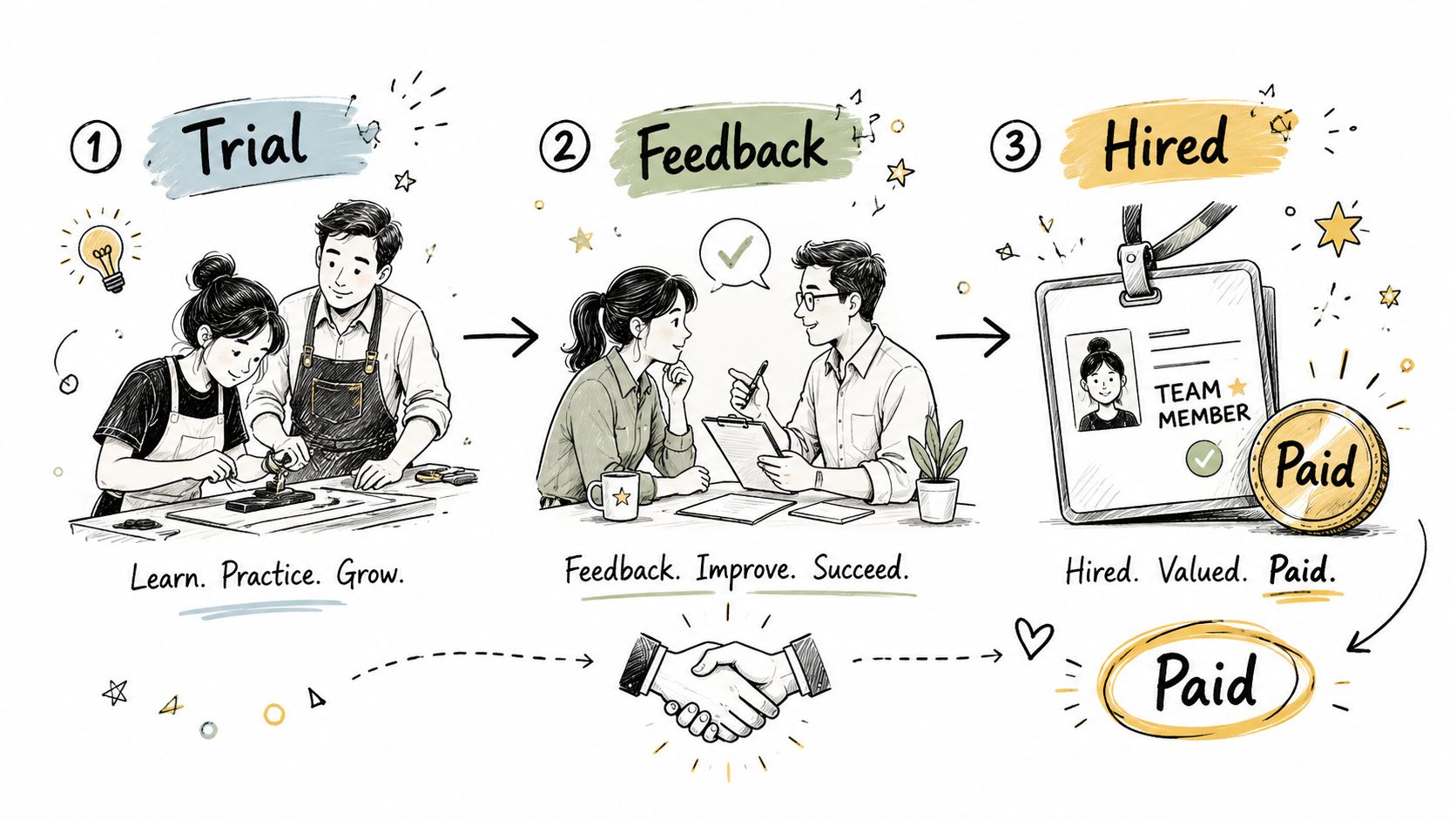
A good trial period should have clear checkpoints.
Define success early: Agree on what performance looks like.
Schedule feedback: Regular check-ins reduce ambiguity.
Document outcomes: Save examples of work quality and reliability.
Build relationships: A supervisor who knows your work can become a reference.
The reason this works is simple. Many autistic job seekers are assessed on interview behavior, not task performance. Trial work shifts the evidence back to actual work, which is where many candidates are strongest. It's a much fairer test.
6. Customized Employment Carving Niche Roles Based on Individual Strengths
Customized employment is one of the most underused job search strategies for autistic adults because it starts with the person's actual strengths, not a standard job description. Instead of trying to fit into a role that was never designed for your work style, you look for a specific employer problem and shape a role around the solution. That's a better match for candidates whose strengths are real but don't always fit mainstream interview narratives.
This can look like quality control for someone with strong pattern recognition, inventory work for someone who loves order and repetition, or data entry tied to a consistent process. The point isn't to ask for special treatment. It's to show an employer a useful function they may not have clearly named yet.
The discovery process matters more than people think. You need to identify both obvious strengths and hidden ones, such as persistence, visual accuracy, memory for routines, or comfort with highly structured work. A counselor who knows customized employment can help translate that into a pitch employers understand.
Present the role as a business solution. If the employer hears “charity,” they hesitate. If they hear “this solves a real workflow problem,” they start listening.
This approach is especially useful when traditional openings keep collapsing in interviews. A candidate who struggles with open-ended self-presentation may still thrive in a carved role with clear tasks and measurable outcomes. The employer gets more precision, the worker gets better fit, and the job becomes more sustainable. That's a more realistic route than forcing yourself into an ill-fitting title just because it's posted online.
7. Leveraging Disclosure and Workplace Accommodations Strategically
Disclosure is not a moral test. It's a decision about timing, risk, and support. Some autistic job seekers benefit from disclosing early so they can request the right accommodations, while others need to wait until they've read the culture more carefully. The right answer depends on the workplace, the role, and how much clarity you have about your needs.
A smart disclosure is specific. Instead of saying “I'm autistic” and hoping the employer understands what that means, explain the conditions that help you do your best work. Written instructions, flexible communication, a quieter workspace, or sensory-friendly scheduling are all concrete examples that employers can implement.
A useful rule is to start with the person or office that handles formal accommodations, usually HR or a designated contact, rather than dropping it casually into an interview with a general supervisor. Have documentation ready if needed, and ask for a follow-up meeting so the request doesn't disappear into a generic email thread.
The 2026 recruiting analysis in Huntr's annual trends report is relevant here because it recommends treating hiring like a measurable funnel and combining market signals with internal metrics. That same mindset helps with disclosure. Track what you asked for, what response you got, and whether the accommodation solved the problem.
If the company has an Employee Resource Group or disability network, use it. Those groups often tell you more about the culture than polished careers pages do. A workplace can say it values inclusion, but the follow-through shows up in whether people return your messages, schedule your requests, and adjust systems without making you beg for basic support.
8. Using Informational Interviews to Explore and Build Employer Relationships
Informational interviews are one of the least intimidating ways to learn how a workplace really operates. Instead of asking for a job, you ask for a short conversation about the work, the environment, and what the day looks like. That lowers pressure and gives you better information than a polished job description ever will.
For autistic job seekers, this matters because uncertainty is often the hard part. A 15 to 20 minute conversation can tell you whether a role is chaotic, structured, noisy, repetitive, or highly social. That's more useful than guessing from a posting. It also gives you a natural way to build relationships without the strain of a high-stakes pitch.
Prepare three to five real questions. Ask about daily tasks, the hardest parts of the role, how the team communicates, and what kind of person tends to do well there. Then end by asking for one additional connection, because warm introductions usually travel farther than cold applications.
If phone calls spike anxiety, start by email. That's still a legitimate first move, and it gives you time to script the opening and closing. You can also volunteer first, then use the informal setting to learn how people work before you ever apply.
The strongest informational interviews feel like research, not performance.
Keep it short: Respect people's time.
Take notes: Write down the practical details you'll forget later.
Follow up clearly: Mention one specific thing you learned.
Watch for fit: A role that sounds good on paper may not be livable in practice.
The value here is that you replace guesswork with evidence. That's a better fit for neurodivergent decision-making, and it usually leads to better long-term matches.
9. Developing a Strong Personal Brand and Portfolio Demonstrating Real Work
If interviews are hard, make the work speak first. A portfolio, sample collection, or documented project history gives employers something concrete to evaluate before they rely on social fluency. That can be a major advantage for autistic candidates whose actual performance is stronger than their interview style.
A good portfolio doesn't need to be huge. Four to eight strong examples are often enough if they show range, care, and results. That might include printing samples, fulfillment work, customer service feedback, design projects, photography, or before-and-after examples of a process improvement you helped make.
Keep the materials easy to access. A digital version helps during applications, and a physical version can be useful in interviews or community events. If you're not sure how to present the work, the portfolio tips for freelancers resource can help you think about organization and clarity, even if you aren't a freelancer.
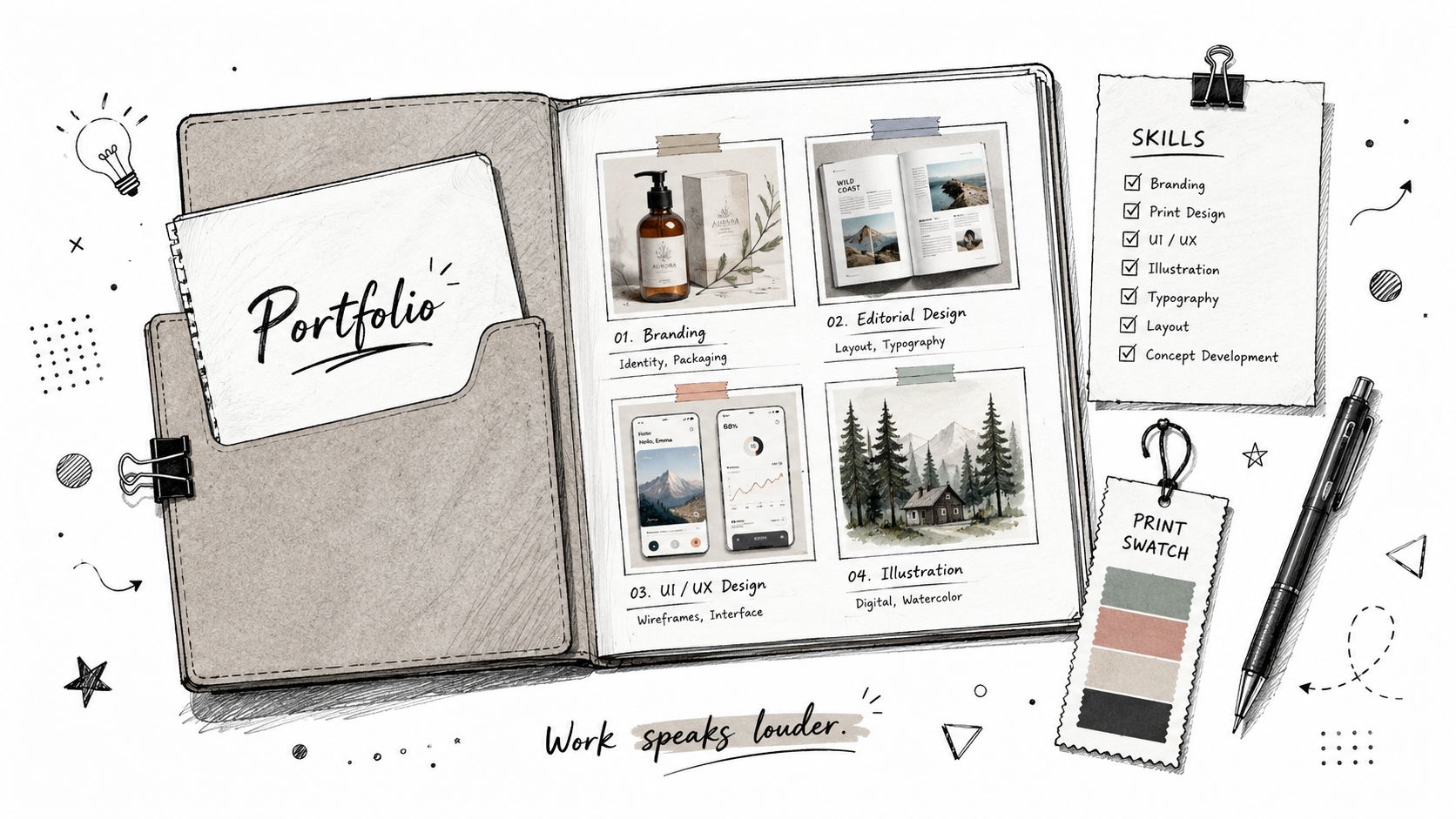
A few practical rules make portfolios stronger.
Choose quality over quantity: Show the work you'd want an employer to remember.
Explain your process: Employers often want to know how you think, not just what you made.
Get permission: Only use samples you're allowed to share.
Tailor the set: Match the portfolio to the kind of job you want.
A strong online presence can help too, but it doesn't need to be performative. A clear LinkedIn profile, a simple summary of your strengths, and evidence of real work can do more than an overproduced personal brand. The point is credibility. If the interview is a weak point, the portfolio becomes your proof.
10. Building Career Readiness Through Mentorship and Role Modeling
Many autistic job seekers don't need motivation speeches. They need contact with people who've already built a working life with similar traits, constraints, or support needs. That's where mentorship and role modeling matter. Seeing another neurodivergent adult hold a job, manage challenges, and stay employed makes the goal feel real instead of abstract.
Good mentors give practical guidance. They can help you decode workplace politics, prepare for a hard conversation, or figure out how to recover after a difficult shift. They can also normalize the fact that career growth doesn't always look linear. That's especially valuable for people who've had stop-start employment histories or long gaps after burnout.
The best matches are usually specific. Look for mentors in similar roles, similar industries, or similar environments. If the person is openly autistic or neurodivergent, that can make the conversations more honest and less exhausting. Still, different mentors can serve different needs. One person may help with interviewing, another with task management, and another with workplace boundaries.
Industry Horror's community-based model is relevant here because it creates a setting where newer trainees can learn from people already doing the work. That kind of peer modeling is often more persuasive than a polished lecture.
Ask for guidance on one concrete problem, not your whole life. Mentorship gets better when the conversation has a clear edge.
A mentor relationship should have clear expectations. Decide how often you'll meet, what kinds of questions are fair to ask, and how you'll keep the exchange mutual. Even offering a small favor, like helping organize a community event or sharing a relevant resource, can keep the relationship balanced. That balance matters for neurodivergent adults who've spent too long in one-sided support systems.
10-Strategy Comparison: Neurodiversity-Affirming Job Search
Strategy | Implementation Complexity 🔄 | Resource Requirements ⚡ | Expected Outcomes ⭐ 📊 | Ideal Use Cases 💡 | Key Advantages ⭐ |
|---|---|---|---|---|---|
Leveraging Neurodiversity-Affirming Job Programs and Training Organizations | Moderate, program coordination, employer partnerships | Moderate–High, trained staff, funding, placement networks | High, practical skills, improved retention, paid placements 📊⭐ | Jobseekers needing supported, structured entry to work | Employer awareness; long-term support; peer community ⭐ |
Building a Comprehensive Accommodation and Support Plan Before Job Searching | Low–Moderate, assessments and documentation steps 🔄 | Low–Moderate, counselor/OT time, assessment tools ⚡ | Moderate, clearer fit, fewer mismatches, legal documentation 📊⭐ | Individuals preparing to disclose or request accommodations | Provides clear, measurable accommodation requests; reduces trial-and-error 💡 |
Networking Through Community Events and Support Groups | Low, attend and follow up regularly 🔄 | Low, time, occasional fees; may need travel ⚡ | Moderate, connections, mentors, some hiring leads 📊 | Building relationships in neurodiversity-friendly spaces | Access to pre-vetted employers; reduced social anxiety; peer support ⭐ |
Utilizing Supported Employment and Job Coaching Services | Moderate–High, individualized coaching plans 🔄 | High, one-on-one coaches, employer coordination ⚡ | High, increased retention, faster on-the-job learning 📊⭐ | Jobseekers needing in-work supports and social coaching | Personalized support; employer advocacy; sustainable placements ⭐ |
Pursuing Internships and Trial Work Periods Before Permanent Placement | Low–Moderate, set objectives and reviews 🔄 | Moderate, paid trial roles preferred; supervisor time ⚡ | Moderate–High, demonstrated competence; pathway to hire 📊 | Candidates who perform better on-the-job than in interviews | Low-risk employer evaluation; builds real work evidence ⭐ |
Customized Employment: Carving Niche Roles Based on Individual Strengths | High, discovery, negotiation, job carving 🔄 | Moderate–High, specialists, employer buy-in ⚡ | High, tailored fit, greater job satisfaction and retention 📊⭐ | Individuals with distinctive skills not matched by standard roles | Leverages unique strengths; solves employer needs; durable matches ⭐ |
Leveraging Disclosure and Workplace Accommodations Strategically | Moderate, timing and documentation decisions 🔄 | Low–Moderate, medical/assessment docs, HR process ⚡ | Moderate, legal protections, reduced masking, better supports 📊 | When legal accommodations are needed or workplace seems receptive | Creates accountability; can reduce burnout and improve authenticity ⭐ |
Using Informational Interviews to Explore and Build Employer Relationships | Low, short, focused conversations 🔄 | Low, time for outreach and prep ⚡ | Moderate, insider knowledge, informal opportunities 📊 | Exploring roles, company culture, or building intro connections | Low-pressure way to learn and get referrals; builds rapport 💡 |
Developing a Strong Personal Brand and Portfolio Demonstrating Real Work | Moderate, compile samples and present professionally 🔄 | Low–Moderate, time, tools, sample permissions ⚡ | Moderate–High, tangible proof of ability; aids selection 📊⭐ | Applicants who struggle in interviews or have demonstrable work samples | Lets work speak first; persuasive for detail-oriented roles ⭐ |
Building Career Readiness Through Mentorship and Role Modeling | Moderate, mentor matching and scheduling 🔄 | Low–Moderate, volunteer/paid mentors, coordination ⚡ | Moderate, improved confidence, modeled workplace behavior 📊 | Early-career seekers needing role models and guidance | Real-world examples; emotional and practical support; network access ⭐ |
Your Path Forward Taking Action on These Job Search Strategies
The strongest job search strategies for autistic adults don't start with pretending to be someone else. They start with support, specificity, and a realistic read on how hiring works. The market is more fragmented than it used to be, AI tools are now mainstream in search, and broad volume alone doesn't reliably produce interviews. That's why the most effective path is usually a combination of targeted applications, relationship-building, supported employment, and accommodation planning.
This approach also respects the reality that many autistic and neurodivergent job seekers have been failed by systems that expected them to mask, self-advocate without support, and survive uncertain workplaces on sheer willpower. Sustainable employment requires more than hustle. It requires environments that understand sensory needs, communication differences, and the value of structured training.
Industry Horror is a concrete example of that model in action. As a 501(c)(3) nonprofit in Ventura, California, it has been providing paid job training and long-term employment pathways since 2013, with real work in customer service, order fulfillment, printing, and workplace readiness. If you want to learn how a neurodiversity-affirming model looks in practice, explore job interview tips alongside the organization's own resources, and consider how support, not pressure, changes outcomes.
You can also support this kind of work in practical ways. Donate if you're able, volunteer if you want to contribute time, and share the model with local employers who need a better way to hire. Industry Horror is also building toward the Autism Avenue Trade School initiative, which points toward a future where hands-on training and employment pathways are designed together instead of disconnected.
The ecosystem is growing, but it still depends on people choosing inclusive hiring, clearer accommodations, and paid pathways instead of empty rhetoric. If you're job searching right now, keep going, but do it in a way that protects your nervous system and builds toward work you can sustain.
Industry Horror offers paid job training, real work experience, and community-based support for autistic adults in Ventura, California. If you want a neurodiversity-affirming model that connects job readiness with sustainable employment, visit Industry Horror and see how their programs, events, and training pathways can fit your next step.


Comments